The instrument
thinks with you.
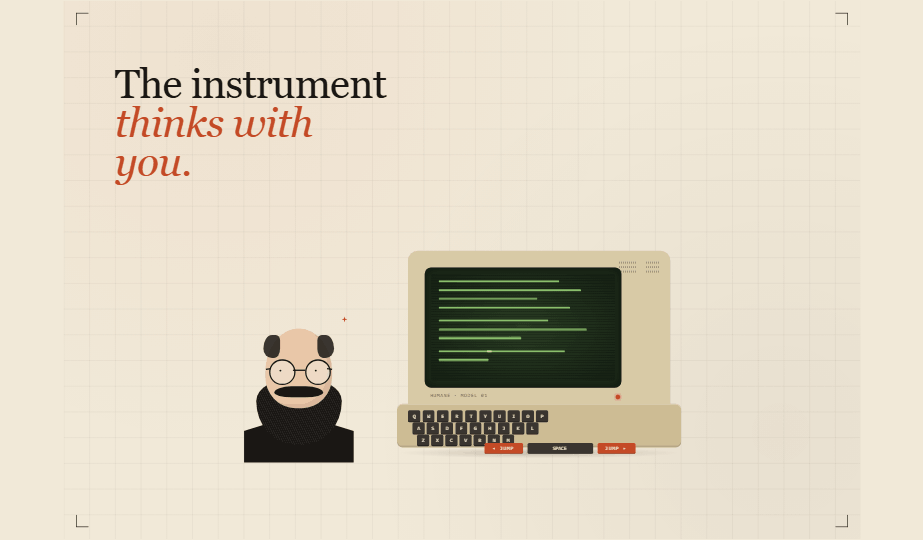
Jef Raskin had a stubborn idea — that the computer should disappear into the work. No modes. No menus to navigate. Just two thumbs, one cursor, and the page in front of you.
RaskinCenter.org preserves the work and legacy of Jef Raskin (1943–2005) — the computer scientist who created the Macintosh project at Apple Computer, designed the Canon Cat, founded the Raskin Center for Humane Interfaces, and spent his career arguing that computers should adapt to human minds rather than require humans to adapt to computers.
Raskin joined Apple as employee number 31 in January 1978. By 1979 he had written the internal memos that proposed the Macintosh — its name, its design philosophy, its target user, its price point. He named it after his favorite apple variety. He hired the first engineers. He articulated the vision that a computer could be so easy to use that it required no instruction.
He died on February 26, 2005, of pancreatic cancer, at 61.
The ideas he spent his career developing remain worth taking seriously. This site collects his published essays, unpublished writings, and the documented work of the Raskin Center for Humane Interfaces — the organization he founded to build software that embodied those ideas.
Jef Raskin Archive
The complete collection of Raskin’s published and unpublished work, organized by category:
Published essays — covering aerodynamics (Coanda Effect, Airfoil), computing history (Holes in the Histories), interface design (Ubiquity interview), mathematics, culture, and society. His paper on the Coanda effect has been cited in Wikipedia and physics literature worldwide. His essay on Mac history corrects a historical record that has been wrong for decades.
Unpublished essays — work Raskin distributed but did not formally publish, including Widgets of the Week, Effectiveness of Mathematics, and Next Time Can Be Worse.
The Humane Interface — a detailed summary of his landmark book (Addison-Wesley, 2000), which proposed designing computer interfaces around human cognition. Still assigned in HCI courses worldwide.
Pictures and personal — photographs from his life as a pilot, pipe organ builder, and naturalist, plus his curriculum vitae.
Raskin Center for Humane Interfaces
The RCHI was the organizational home for Raskin’s later work. It built Archy — an open-source computing environment designed to be modeless, application-free, and navigated entirely through the LEAP search system. It also researched ZUIs (zoomable user interfaces) as an alternative to the folder-hierarchy model.
The RCHI’s work demonstrated, in working software, that the principles Raskin described in The Humane Interface were implementable — not just theoretical. Archy ran. Users could use it. The tradeoffs were real and specific, not abstract.
→ RCHI overview · Archy introduction · Core principles · ZUI specification